A Neighborhood Reinvestment Program exploring a long-term, community-led approach to funding real change for our iconic neighborhood.
Hollywood Can’t Run on Name Recognition Alone.
- It needs cleaner, safer, brighter streets, not conditions people have learned to tolerate.
- It needs aging infrastructure repaired or replaced, not patched and forgotten.
- It needs vacant storefronts filled and private investment encouraged, not decline accepted as inevitable.
- It needs businesses, small and large, to be able to thrive, not just survive.
- It needs activation and beautification that bring energy to the neighborhood, not a quiet existence.
- It needs a creative economy that keeps Hollywood alive, not just remembered.
And just as important, it needs the ability to maintain progress once it’s made. Too often, improvements come as short-term fixes, rolled out, celebrated, and never fully sustained.
Hollywood Needs All of Us.
The challenges are real, but so are the choices.
Hollywood Scene Change: A Neighborhood Reinvestment Program is how we’re exploring sustainable, community-led ways to move forward together. Scroll down to learn more about the approach.
Why Now?
Since early 2024, The Hollywood Partnership (THP) and the Hollywood Partnership Community Trust (HPCT) have been exploring long-term funding options to strengthen services and stewardship within the Hollywood Entertainment District. Over time, the level of investment and care needed to support this iconic area has not consistently kept pace, creating a growing gap between what people expect from Hollywood and what they experience on the ground. Based on early stakeholder feedback on this effort, the work has been refined into a clear path forward.
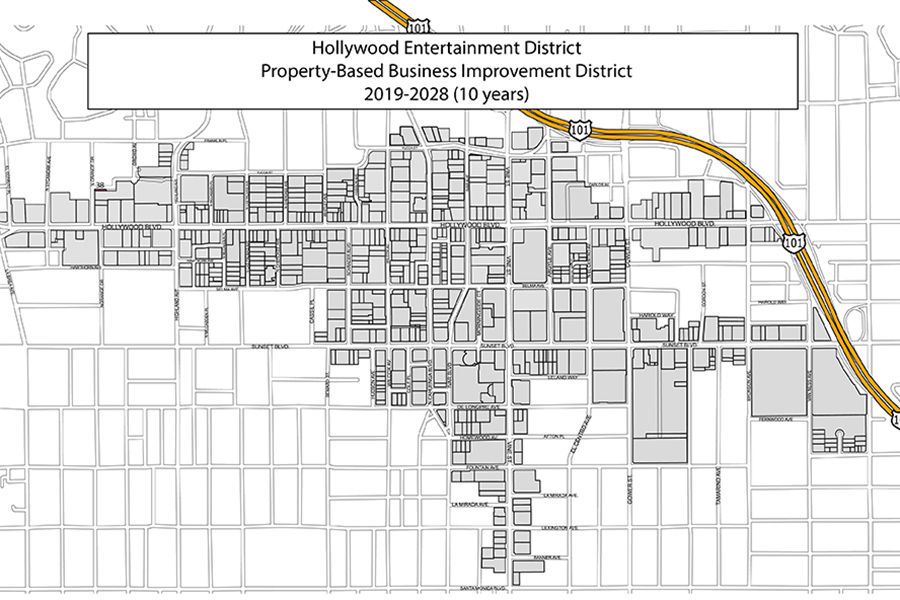
While Hollywood is often spoken about as a whole, THP’s role is focused on the Hollywood Entertainment District, where enhanced services, maintenance, and public-realm improvements are delivered.
What Is the Neighborhood Reinvestment Program?
The Neighborhood Reinvestment Program (NRP) brings together two complementary funding tools designed to work in tandem, supporting a unified, long-term approach to investment, services, and neighborhood care.
Hollywood Tourism Improvement District (HTID)
A tourism-based assessment district that generates revenue from visitor-serving businesses to fund enhanced services, marketing, and public-realm improvements that support Hollywood’s role as a global entertainment destination.
Hollywood Entertainment District (HED) PBID Early Renewal
A property-based business improvement district renewed early to align with HTID planning, supporting coordinated service delivery, unified community outreach, and a comprehensive long-term vision for the neighborhood.
Together, these programs form the Neighborhood Reinvestment Program (NRP): A coordinated framework enabling comprehensive vision-setting, revenue forecasting, service planning, and community engagement for Hollywood’s future.
What Sustainable Funding Makes Possible
Sustainable funding gives Hollywood the ability to match the intensity of daily use—by strengthening core services and creating real capacity for district improvements that are difficult to sustain with today’s baseline resources.
Tier 1: Strengthening the services that matter most
The first priority of sustainable funding is to significantly expand the core services that already play a critical role in Hollywood today— particularly safety and cleaning.
Safety
Expanded presence, faster response, and stronger coordination to match daily activity.
Cleaning
Increased frequency and coverage for a high-traffic, 24/7 destination.
Tier 2: Going beyond today’s baseline
Sustainable funding creates room to expand work that is currently limited by available resources.
Economic Development and Business Vitality
A dedicated economic development function focused on storefront activation, tenant recruitment, and long-term business health—moving beyond reactive vacancy management to a proactive, district-wide strategy.
Marketing, Communications, and Tourism
Expanded brand, destination, and tourism marketing that reflects Hollywood’s scale and reach—supporting visitor demand, investment, and major activations.
District Modernization and Signage
Advancing updates to the Hollywood sign code to support modern signage and visibility along Hollywood Boulevard, paired with the ongoing management needed to ensure quality and consistency over time.
Visitor Services and Public Restrooms
Supporting the operation and maintenance of Hollywood’s first dedicated visitor center and public restroom facility—critical destination infrastructure that requires sustained funding to function safely and reliably.
Arts, Culture, and Public Realm Activation
Activating streets and public spaces through special events and public art—creating energy, pride, and shared experiences throughout the district.
Hospitality and Welcome Services
Reintroducing and growing a dedicated hospitality program. In previous years, this team was reduced as funding shifted to cover safety and cleaning needs. Scene Change allows this work to return and grow.
Have Questions or Feedback?
We want to hear from you. The Hollywood Partnership is committed to transparency and open communication throughout the Scene Change process. If you have questions, feedback, or want to learn more, reach out anytime.
Email The Hollywood PartnershipTimeline: From Exploration to Action
A transparent look at how research, feedback, and planning have shaped the current proposal.
Initial Exploration Begins
THP and HPCT begin exploring formation of a Tourism Improvement District (HTID).
Board Reviews Initial Draft Framework
The Board reviews an initial framework and advances it for refinement and stakeholder engagement.
Stakeholder Feedback Shapes the Approach
Stakeholder feedback helped shape a revised approach grounded in community priorities.
Regroup and Prepare the Dual-Funding Framework
This phase focuses on regrouping and preparing the framework for the updated dual-system approach—aligning assumptions, service planning, and outreach materials so the next phases can move forward with clarity.
Outreach and Core Documents Finalized
This phase focuses on two things:
- Community outreach through focus groups, roundtables, and community meetings
- Finalizing core documents including the Economic Impact Study and Engineer’s Report
- Draft Management District Plan review at the committee level and Board consideration
City Submission and Expanded Roundtables
Draft packages are submitted to the City while outreach continues through roundtables and community meetings. As feedback is received, materials are refined and resubmitted to strengthen the plan.
Petition Drive and Education Campaign
A public-facing education campaign launches alongside the petition drive to ensure stakeholders understand the proposal and how it works.
City Hearings and Required Actions
The process moves through the City’s required hearings and actions connected to the petition phase.
Process Split: HTID Prep and PBID Ballot Phase Begins
This is where the HTID and PBID paths diverge. If the HTID petition is successful, implementation planning and education begin. Meanwhile, the PBID moves into the ballot voting phase—ballots are issued and collected for the renewal.
PBID Ballot Voting and HTID Collections Begin
PBID ballots continue through voting and final City actions, while HTID assessment collections begin coming in—creating the funding runway needed to prepare for new district operations in 2028.
Operating Budget Approved
Governance and implementation details are finalized, including approval of the operating budget for the first year of services.
District Operations Begin
District operations launch and services begin under the approved plans, bringing Scene Change into day-to-day delivery.
Initial Exploration Begins
THP and HPCT begin exploring formation of a Tourism Improvement District (HTID).
Board Reviews Initial Draft Framework
The Board reviews an initial framework and advances it for refinement and stakeholder engagement.
Stakeholder Feedback Shapes the Approach
Stakeholder feedback helped shape a revised approach grounded in community priorities.
Regroup and Prepare the Dual-Funding Framework
This phase focuses on regrouping and preparing the framework for the updated dual-system approach—aligning assumptions, service planning, and outreach materials so the next phases can move forward with clarity.
Outreach and Core Documents Finalized
This phase focuses on two things:
- Community outreach through focus groups, roundtables, and community meetings
- Finalizing core documents including the Economic Impact Study and Engineer’s Report
- Draft Management District Plan review at the committee level and Board consideration
City Submission and Expanded Roundtables
Draft packages are submitted to the City while outreach continues through roundtables and community meetings. As feedback is received, materials are refined and resubmitted to strengthen the plan.
Petition Drive and Education Campaign
A public-facing education campaign launches alongside the petition drive to ensure stakeholders understand the proposal and how it works.
City Hearings and Required Actions
The process moves through the City’s required hearings and actions connected to the petition phase.
Process Split: HTID Prep and PBID Ballot Phase Begins
This is where the HTID and PBID paths diverge. If the HTID petition is successful, implementation planning and education begin. Meanwhile, the PBID moves into the ballot voting phase—ballots are issued and collected for the renewal.
PBID Ballot Voting and HTID Collections Begin
PBID ballots continue through voting and final City actions, while HTID assessment collections begin coming in—creating the funding runway needed to prepare for new district operations in 2028.
Operating Budget Approved
Governance and implementation details are finalized, including approval of the operating budget for the first year of services.
District Operations Begin
District operations launch and services begin under the approved plans, bringing Scene Change into day-to-day delivery.
Have Questions or Feedback?
We want to hear from you. The Hollywood Partnership is committed to transparency and open communication throughout the Scene Change process. If you have questions, feedback, or want to learn more, reach out anytime.
Email The Hollywood PartnershipHow Hollywood Stacks Up
Hollywood’s public-realm needs have outpaced available funding. To understand the scale of the gap and what it takes to deliver a competitive visitor and resident experience, we compared Hollywood to peer improvement districts and to neighboring cities that compete for residents, investment, and visitor spending.
Purpose of the Comparison
This analysis is intended to clarify how Hollywood’s role as a destination aligns with the resources currently available to support that role.
- District Investment Context How Hollywood’s current district-level investment compares to peer districts that manage similarly intensive public-realm environments.
- City Service Starting Point How the City of Los Angeles service baseline compares to neighboring cities with stronger per-capita resourcing, which establishes the level of service Hollywood starts from.
- Service Gap Implications Whether Hollywood begins from a lower baseline, meaning district funding must first close a gap before a competitive experience can be delivered.
Methodology and Selection Criteria
To ensure comparisons are meaningful, the analysis was structured around three lenses that reflect how public-realm services are funded and delivered.
- Benchmark Improvement Districts Selected districts share comparable public-realm operating models, including entertainment districts and industry-centered districts that attract tourism while serving residents and workers.
- Scaled Annual Investment Measures Investment was evaluated using total budgets and scaled measures such as per square mile and per visitor to account for differences in size and intensity of use.
- Neighboring Municipal Service Baselines Los Angeles was compared to nearby cities using per-capita spending levels to understand baseline service differences before district-level investment is added.
The sections below present the supporting analysis, beginning with district comparisons and then moving to Los Angeles versus neighboring cities to contextualize baseline public service levels.
How Hollywood Compares to Benchmark Improvement Districts
Investment per Square Mile
Investment per Person Served
What This Means
Peer-level service averages about $0.82 per person served annually across benchmark districts.
Hollywood serves roughly 34.5 million people per year across visitors, residents, and daily users.
Using the peer benchmark at Hollywood’s scale yields about $28.3M, which supports a $25–30M annual target for peer-level service delivery.
City of Los Angeles vs. Neighboring Cities
Hollywood functions like a small city, serving a massive daily population and supporting a resident base comparable to nearby municipalities. But Hollywood is a neighborhood within Los Angeles, not its own city. That means core public services are funded through Los Angeles’ citywide budget, and Hollywood receives only a portion of those resources despite the intensity of use and demand placed on this area.
The Case for Local Investment
Hollywood cannot rely on City of Los Angeles general fund allocations alone to remain competitive with peer districts and neighboring municipalities.
An annual operating range of $25 million to $30 million achieved through local, sustainable funding mechanisms enables Hollywood to deliver a visitor and resident experience comparable to established benchmarks.
This investment is not aspirational. It is necessary.
Have Questions or Feedback?
We want to hear from you. The Hollywood Partnership is committed to transparency and open communication throughout the Scene Change process. If you have questions, feedback, or want to learn more, reach out anytime.
Email The Hollywood PartnershipStakeholder Survey Results
Stakeholders shared feedback on current conditions, audience experience, and priorities for improving Hollywood’s public realm. The results highlight clear patterns—both in the challenges people are experiencing and the work they believe is most important moving forward.
No Excellent Ratings
Current conditions scored 3 (Okay) or less on all factors; most averaged 2 (Poor).
Poor Experiences
No audience segment was perceived to have a Good or Excellent experience.
High Importance
All initiatives averaged 4 (Slightly Important) on a 5-point scale.
Resource Disconnect
Stakeholders align on challenges but differ on the scale and source of resources needed.
Current Conditions Assessment
Stakeholders rated factors on a scale from 1 (Terrible) to 5 (Excellent). Not a single factor received an average rating of 4 (Good) or higher.
1 — Terrible
2 factors
- Public Restrooms
- Vacant / Neglected Buildings
2 — Poor
17 factors
- General Cleanliness
- Condition of Sidewalks
- Condition of Streets
- Litter / Trash
- Unhoused Individuals / Encampments
- Street Vending
- Graffiti
- Parking
- Visitor / Customer Foot Traffic
- Vehicular Traffic
- Public Art
- Trees / Landscaping
- Community Events / Programming
- Restaurant Options
- Retail Options
- Permitting / Zoning Regulations
- Public Safety
3 — Okay
3 factors
- Lighting
- Entertainment Options
- Hotel / Lodging Options
Overall Experience by Audience
Stakeholders assessed how five key audiences currently experience Hollywood. The pattern is consistent: most audiences are perceived as having a Poor or Terrible experience.
Top Challenges & Strengths
Stakeholders were given the opportunity to share open-ended responses about the #1 factor influencing Hollywood today, and clear patterns emerged—both negative and positive.
Initiative Priorities
All 18 proposed initiatives averaged a rating of 4 (Slightly Important) on a 5-point scale from Very Unimportant (1) to Very Important (5). This uniformity suggests stakeholders view comprehensive action as necessary.
The Disconnect
Stakeholders strongly agree on Hollywood’s challenges: poor conditions, negative experiences across all audiences, and the importance of comprehensive initiatives.
Yet there remains a disconnect on the scale and source of resources needed to address these challenges effectively.
This gap between consensus on problems and alignment on solutions underscores the urgency of Scene Change: to establish a sustainable, local funding mechanism at a scale that matches the scope of the challenge.
Have Questions or Feedback?
We want to hear from you. The Hollywood Partnership is committed to transparency and open communication throughout the Scene Change process. If you have questions, feedback, or want to learn more, reach out anytime.
Email The Hollywood PartnershipAbout The Hollywood Partnership
The Hollywood Partnership (THP) is the nonprofit that helps keep the Hollywood Entertainment District clean, safe, and welcoming. Here is how the organization is structured and what the team delivers every day in the public realm.
Who We Are
How We Are Funded
How We Are Governed
What We Do Every Day
THP’s work focuses on four main goals that keep Hollywood thriving.
Place Management
THP’s Place Management program keeps Hollywood clean, safe, and welcoming through around-the-clock care and on-demand non-emergency assistance.
Place Enhancement
THP’s Place Enhancement program invests in the beauty and vitality of Hollywood through planting trees, landscaping medians, painting light poles, curbs, and street furniture, facilitating public art projects, and more.
Stakeholder Engagement
THP’s Stakeholder Engagement goal strengthens connection and understanding in Hollywood by serving as the district’s primary information source, managing digital channels, leading communications, and energizing the streets through events like LA Pride and live concerts.
Advocacy & Economic Development
THP’s Advocacy & Economic Development goal drives growth and investment in Hollywood by producing key projects like Market Reports, Data Dashboards, Business Resources Kits, and Retail & Development Tracking that help inform decisions and promote the district’s economic vitality.
Have Questions or Feedback?
We want to hear from you. The Hollywood Partnership is committed to transparency and open communication throughout the Scene Change process. If you have questions, feedback, or want to learn more, reach out anytime.
Email The Hollywood Partnership