Q1 2026 · Quarterly Market Report
Inside Q1 2026
Your window into the energy, economy, and evolution of the Hollywood Entertainment District

CEO Message
Welcome to the Q1 2026 edition of Market Moves. As we enter a new year, the data tells a story that feels increasingly familiar in Hollywood: not one of dramatic swings or short-term rebounds, but of steady progress. After years defined by disruption, recovery, and recalibration, Hollywood is settling into a new phase — one focused on growth, investment, and long-term positioning.
The purpose of this dashboard is simple: to provide a clear, data-driven understanding of how Hollywood lives, works, welcomes, and evolves. Whether you are a property owner, business leader, investor, resident, policymaker, or community stakeholder, our goal is to make complex information more accessible and help illuminate the trends shaping the district.
This quarter, we have also introduced a new feature: Data Geographies. One of the most common questions we receive is, "What area are these numbers actually measuring?" Depending on the dataset, the answer may be the Walk of Fame, the Hollywood Entertainment District, Greater Hollywood, or another geography. To provide greater transparency and consistency, every section now includes a reference guide identifying the boundaries associated with each metric.
Beyond the individual numbers, several themes stand out this quarter.
First, confidence is returning to the market. Across multiple sectors, we are seeing evidence that investors, businesses, developers, and consumers continue to place long-term bets on Hollywood. New businesses are opening, major projects are moving forward, and private investment remains active despite broader economic uncertainty.
Second, quality continues to outperform. The strongest-performing assets, destinations, and experiences are those that offer something distinctive — whether that is premier office space, thoughtfully curated retail, destination dining, or cultural experiences that cannot be replicated elsewhere. Hollywood's competitive advantage has never been about being the biggest; it has always been about being uniquely Hollywood.
Third, the district continues its evolution into a more complete neighborhood. While Hollywood remains one of the world's most recognizable entertainment destinations, it is increasingly also a place where people live, work, and build community. Residential growth, new neighborhood-serving businesses, and ongoing public realm investments are contributing to a more active and balanced district throughout the day and evening.
Finally, culture remains Hollywood's greatest asset. Even as the entertainment industry itself navigates significant transformation, Hollywood continues to serve as a gathering place for creativity, performance, music, storytelling, and shared experiences. The district's cultural relevance remains one of its most enduring strengths and a key driver of its future success.
The data presented throughout this report reflects a district that is continuing to adapt, invest, and evolve. Challenges remain, as they do in every urban center, but the overall trajectory is encouraging. Hollywood is attracting investment, welcoming new residents and businesses, and reinforcing its position as both a global destination and a thriving urban neighborhood.
Thank you for taking the time to explore this quarter's report. We hope the insights contained within help inform your decisions, strengthen your understanding of the district, and contribute to a shared vision for Hollywood's future.
Kathleen Rawson
President & CEO
The Hollywood Partnership
How It Works
Getting started is easy — here's what to do:
*For the best experience and full data visibility, this dashboard is best viewed on desktop.
Start by selecting a topic using the tabs at the top of the page. You can explore six key areas of Hollywood through Market Snapshot, Working, Living, Visiting, Retail, and Development.
Use the on-page section buttons to jump directly to the information you're most interested in. When you're ready to return to the top, tap the up-arrow button in the lower right-hand corner.
Have questions or need help navigating the dashboard? Email us anytime at info@hollywoodpartnership.com.
What You Can Explore
Six topics covering everything happening in Hollywood:
A quick, big-picture look at who is in the district and how the HED is being used throughout the year.
A closer look at Hollywood's labor market, creative economy, and business landscape.
A snapshot of residential trends, housing supply, and affordability across the district.
How Hollywood performs as a destination, including tourism, attractions, and hotel activity.
How people spend, shop, and move through Hollywood's retail environment, including consumer behavior and market conditions.
A live map of projects shaping Hollywood's future across office, residential, hotel, and retail sectors.
About the Hollywood Entertainment District
The Hollywood Entertainment District (HED) is a vibrant 80-block neighborhood at the heart of Los Angeles and one of the region's most iconic and dynamic urban centers. Home to world-famous landmarks, creative industries, diverse businesses, and a thriving residential community, Hollywood is where culture, commerce, and innovation converge every day.
With residents, workers, visitors, and creators moving through the district around the clock, the HED functions simultaneously as a neighborhood, an employment center, a tourism destination, and a cultural engine for the region.
MARKET SNAPSHOT
Hollywood is more than a destination, it's a living ecosystem of residents, workers, and visitors who keep the district vibrant day and night. This snapshot offers a quick look at how people engage with the Hollywood Entertainment District (HED), revealing key trends in activity, visitation, and momentum across work, live, and play.
Data Geographies
Click to enlarge
—
—
Used in
People in Hollywood
Data reflects year-to-date activity through Q1 2026"People in Hollywood" includes visits from any pedestrian who lives, works, visits, or passes through the Hollywood Entertainment District for more than 10 minutes at a time. If you spend time here on a typical day, your visit(s) count in this data.
Every day, a diverse mix of residents, workers, and visitors brings Hollywood to life. This section provides a snapshot of who is here, when they are here, and how they interact with the district. Together, these insights across population patterns, generational and demographic makeup, long-term visitation, and pedestrian activity reveal the daily and seasonal rhythms that define Hollywood.
People in the HED by Generation
Millennials and Gen Z together represent 65% of HED daily users — Hollywood's entertainment and cultural offering resonates strongly with younger urban audiences.
People in the HED by Race & Ethnicity (Residents & Workers Only)
Hollywood's daily visitor base is notably diverse — Latinx and White visitors each account for roughly 40% of traffic, reflecting the district's regional and global draw.
—
—
Pedestrian Counts
Data reflects weekly and monthly activity through Q1 2026This data shows how pedestrian activity moves through the Hollywood Entertainment District, highlighting daily rhythms, seasonal patterns, and the significant impact of major events on street-level activity over time.
Annual
Jan – Dec 2025
Total People
Q1 2026
Jan – Mar
Total People
Latest Week
Week of 6/28–7/4/2026
Total People
* Data can be delayed up to 2–3 weeks.
Pedestrian Counts by Day of Week
Daily breakdown of tourist, worker, and resident activity patterns across the week of 6/28–7/4/2026 compared to the same week in 2025 and 2019.
Daily Breakdown by People Type
Compare Year
Pedestrian Counts by Month
Month-by-month totals comparing 2026, 2025, and 2024 for the Hollywood Entertainment District.
Q1 2026 totaled 9.1M (+5.8% vs Q1 2025). January 2026 reached 2.82M (+14% YoY) as the district recovered from the LA Wildfires that suppressed January 2025. February tracked at 2.64M and March at 3.02M, both ahead of their 2025 comparables. Peak months in 2025 were July at 3.10M and October at 3.17M.
Weekends Drive Volume
Friday through Sunday consistently accounts for the majority of weekly pedestrian traffic, with Saturday peaking at 130.9K — nearly 50% above the typical weekday baseline.
Tourist Activity Leads
Tourists represent the dominant pedestrian segment throughout the week, peaking on weekends. Worker and resident activity provides a stable weekday baseline.
Summer & Fall Peak Seasonality
July and October are consistently the highest-traffic months of the year, driven by summer tourism and fall event programming. January remains the softest month district-wide.
Hollywood peaks on major event days
Typical days maintain a steady baseline, while major cultural moments consistently drive the district's highest pedestrian volumes.
-
Typical Weekday92K
-
Typical Weekend127K
-
High-Attendance Days Top 5%138K
-
Peak Day LA Pride156K
Examples of High-Attendance Event Days
LA Pride
2023–2025
133K–156K
Halloween Weekends
2023–2025
138K–151K
Major Hollywood Blvd Concerts
2023–2025
129K–135K
Hollywood at a Glance
Data reflects year-to-date activity through Q1 2026This snapshot pulls together key indicators across Hollywood's business, residential, hotel, retail, and visitor economy — offering a quick pulse check on how the district is performing today.
Total Businesses in HED
Office Space in HED
Workers in HED Daily
Office Projects in Development
Total Multifamily Units in HED
Avg. Monthly Asking Rent
Residents in HED
Multifamily Projects in Development
Total Hotel Rooms in HED
Avg. Daily Room Rate (ADR)
↑ +5.9% QoQ
Domestic Tourists in HED
Hotel Projects in Development
Retail Space in HED
Monthly Retail Rent
↓ −4.8% QoQ
Retail Projects in Development
Avg. Tourist Household Income
Showcasing Hollywood
Hollywood's Entertainment District is the heartbeat of the global entertainment industry, home to hundreds of Walk of Fame stars, historic theatres, and world-famous red carpet events. From the Oscars to LA Pride, the district continues to attract audiences, talent, and investment from around the world.
2,800+
Stars on the Walk of Fame
30+
Theatres
20,000+
Theatre Seats
50+
Red Carpet Events Annually
Optimal Urban Mix
Research from Cushman & Wakefield and the Places Platform shows that the ideal balance for thriving real estate markets is 42% Work, 32% Live, and 26% Play. This mix drives the highest real estate value and GDP per acre, fostering vibrant and resilient urban districts. The Hollywood Entertainment District already outperforms many downtowns that remain overly reliant on office use.
Market Snapshot
A printable one-page snapshot of Hollywood's key Q1 2026 indicators.
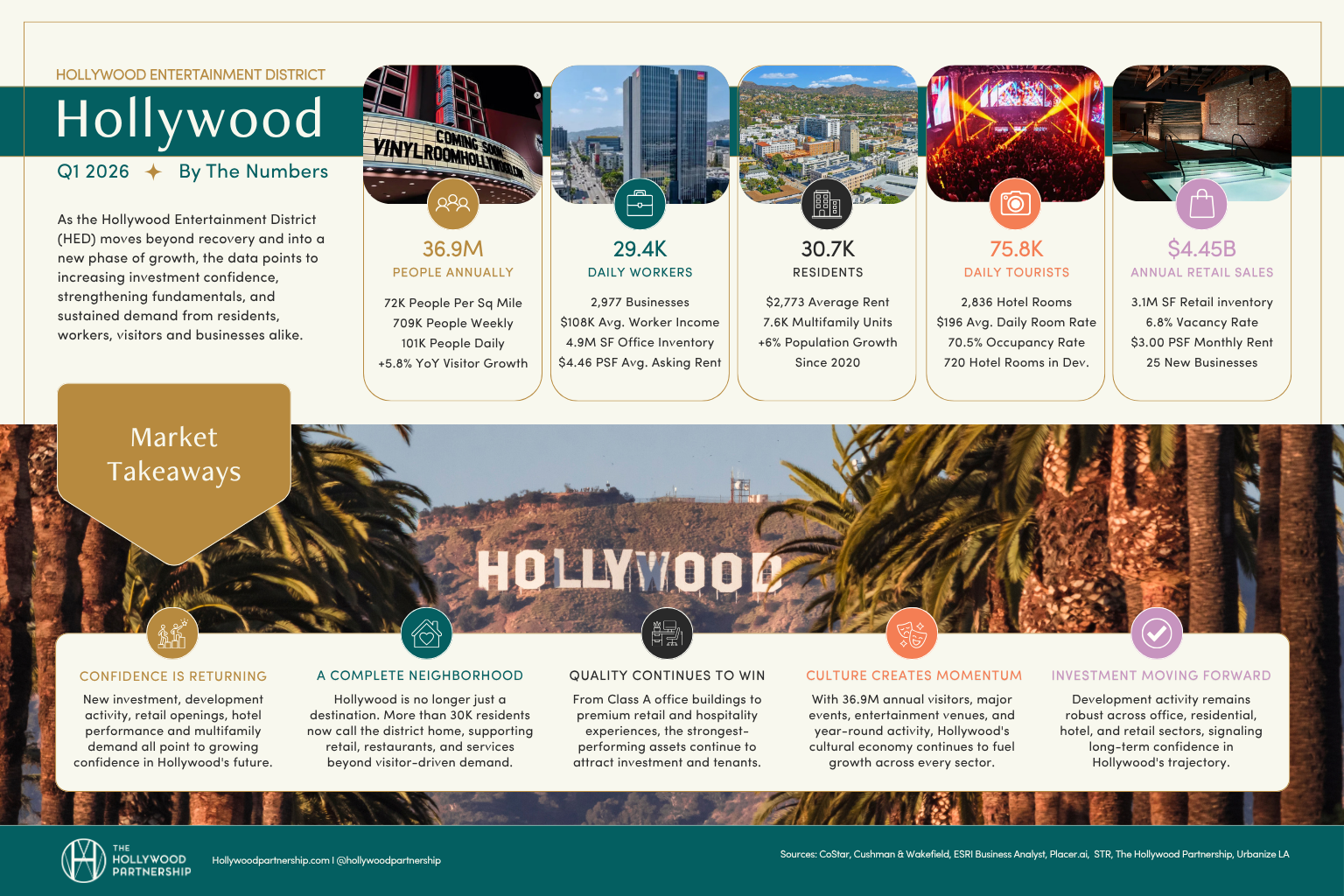
Snapshot Data Sources: CoStar, Cushman & Wakefield, ESRI Business Analyst, Placer.ai, The Hollywood Partnership, Urbanize LA, US Census, ZIMAS
WORKING IN HOLLYWOOD
At its core, Hollywood is a hub of creativity and storytelling. Anchored by a powerful entertainment production ecosystem and a globally recognized name, the district blends laid-back Southern California culture with the drive and innovation that define the industry. While Hollywood remains a center for film, television, and music production, its employment base is broad and diverse, supporting a wide range of sectors that contribute to the district's economic strength.
Data Geographies
Click to enlarge
—
—
Used in
Workforce & Business Landscape
Data reflects year-to-date activity through Q1 2026A quick view of the employment and industry mix that powers Hollywood, from entertainment and creative production to the wide range of sectors that support the district's daytime economy.
HED Worker Population
30.4K
Total Workers
HED Worker Trends
1.2M
Worker Visits to HED (Q1 2026)
HED Employment Profile
2,977
Total Businesses
HED Workers by Race & Ethnicity
Latinx workers represent the largest share at 48%, followed by White at 31% and Asian at 14%.
HED Employment by Industry
Professional & Technical Services and Information each account for 13% of employment, followed by Accommodation & Food at 12% — reflecting Hollywood's entertainment-anchored but broadly diversified economy.
Shifting Work Patterns
Worker visits to the Hollywood Entertainment District remained below pre-pandemic levels in Q1 2026 and were modestly down year over year. These trends continue to reflect evolving workplace patterns across the region, including hybrid work adoption, changing commuting behavior, and broader shifts within the entertainment and office sectors.
Hybrid and flexible work schedules continue to influence weekday pedestrian volumes, with midweek visitation remaining stronger than Mondays and Fridays.
Hollywood's worker data captures a broad mix of employees beyond traditional office workers, including hospitality staff, production crews, service workers, contractors, vendors, and retail employees. Small shifts across these support workforce categories can significantly impact overall worker visitation patterns.
Ongoing adjustments within the entertainment, media, and office sectors likely contributed to lower recurring weekday worker trips throughout the district.
Despite softer worker visitation, increased tourism, nightlife, and entertainment activity helped support overall district foot traffic and street-level activity.
1.2M
Worker Visits to HED
Q1 2026 (1,232,287)
−2.6%
Change vs. Prior Year
Q1 2025
−21%
Of Pre-Pandemic Levels
Q1 2019 Baseline
HED Quarterly Worker Visits Over Time
Worker visits in Q1 2026 totaled 1.2M, down 2.6% from Q1 2025 and 21% below the Q1 2019 pre-pandemic baseline.
HED Worker Jobs by Distance (2023)
Over half of HED workers (56%) commute from less than 10 miles away, with another 26% traveling 10–24 miles — reflecting a predominantly local workforce.
—
—
Office Market Conditions
Data reflects year-to-date activity through Q1 2026Trends in office supply, leasing activity, and vacancy across Hollywood and the broader market. While national office markets continue to adjust to hybrid work and evolving tenant demand, Hollywood's office landscape reflects a more resilient mix of creative, production, and Class A space relative to citywide conditions.
Overall Office Inventory
4.9M SF
Total Hollywood Office Space
Overall Avg. Monthly Asking Rent
$4.46 PSF
Per Square Foot Per Month
Overall Vacancy
23.8%
Hollywood Overall Vacancy Rate
Premium Tier
Class A Performance
Inventory
3.2M SF
65% of total market
Avg. Monthly Asking Rent
$5.47 PSF
≈ 23% premium vs overall
Vacancy
20.1%
≈ 3.7pp better than overall
Overall Market
Comparative benchmarks
HWD Overall Avg. Monthly Asking Rent (Q1 2026)
$4.46 PSF
HWD Overall Vacancy Rate (Q1 2026)
23.8%
Class A Tier
Comparative benchmarks
HWD Class A Avg. Monthly Asking Rent (Q1 2026)
$5.47 PSF
HWD Class A Vacancy Rate (Q1 2026)
20.1%
In office markets, rising rents typically reflect stronger demand, while falling vacancy rates indicate healthier absorption. The arrows and colors are calibrated to show these as positive movements.
Overall Vacancy Rates By Quarter
Hollywood's overall vacancy reached 23.8% in Q1 2026 — up 4.2pp from Q1 2025 and 0.2pp above the citywide rate of 23.6%.
Class A Vacancy Rates By Quarter
Class A vacancy reached 20.1% in Q1 2026 — still 6.2pp below Greater LA's 26.3%, reflecting continued relative strength in Hollywood's premium tier.
Regional Overall Office Vacancy Rates Over Time
Hollywood's 23.8% vacancy in Q1 2026 sits below Downtown CBD (31.7%) and Downtown Non-CBD (33.2%), tracks near LA West (23.1%), and slightly trails Greater LA's 23.6%.
Annual Avg. Asking Rents (PSF) Over Time
Hollywood's annual avg. asking rent rose to $53.52 PSF in Q1 2026, recovering from $49.68 in Q4 2025 but still down from $58.20 in Q1 2025. Hollywood remains second only to LA West ($59.16) among LA submarkets.
Net Absorption
Quarterly Change in Occupied Office SpaceNet absorption tracks how much office space becomes newly occupied versus newly vacated each quarter. Positive values indicate growing demand, while negative values reflect contraction. In recent quarters, Hollywood's net absorption has turned negative, though declines remain less pronounced than those seen across the broader Los Angeles office market.
As of Q1 2026
−34,116 SF
Net Move-Out
Momentum
The last 4 quarters negative
Recent Trend
Relative Performance
Hollywood declines are less severe than Greater LA
Market Comparison
Hollywood Quarterly Net Absorption
Q1 2026 net absorption was −34,116 SF, an improvement from Q4 2025's −48,794 SF. Hollywood has now seen four consecutive quarters of negative absorption, though contraction has continued to moderate.
Hollywood & Citywide Quarterly Net Absorption
Hollywood's declines remain consistently less severe than Greater LA's. While Greater LA recorded −1.13M SF in Q1 2026, Hollywood's −34,116 SF reflects a more contained contraction.
—
—
TOP STORIES
In response to shifting production trends, Sunset Studios, a division of Hudson Pacific Properties, is launching pre-built, turnkey soundstages in Hollywood designed for smartphone-first content. Partnering with production company Knockout Shorts, the firm is converting an 8K SF stage into standing sets like courtrooms and hospitals. As Los Angeles soundstage occupancy dips to the low 60% range, these "vertical dramas" represent a burgeoning $10 billion asset class. The move allows creators to avoid the logistical hurdles of filming on location; instead, they gain immediate access to a permitted lot with professional amenities, including production offices, parking, and on-site cafes. By removing the friction of custom builds and permitting, Sunset Studios is positioning itself to capture a new wave of mobile-first creators who prioritize speed and efficiency over traditional long-term leases.
Hollywood isn't just where the world comes to visit; it's where global brands come to work. With nearly 3,000 businesses and 29,000 employees in the Hollywood Entertainment District (55K employees in Greater Hollywood), the neighborhood has become one of LA's most sought-after headquarters destinations. Netflix anchors the district's creative identity, while Kim Kardashian's Skims claimed 116K SF at 1601 Vine for its flagship HQ. Puma opened a Hollywood creative studio in 2025 to tap into the neighborhood's unmatched cultural influence. Hasbro is relocating its entire media-and-entertainment division, spanning film, TV, gaming, and AI, to the nearby WeHo Lot at Formosa by Q1 2027. The Entertainment Fund, Com2uS, Capitol Records, Universal Music Group, Live Nation, Sunset Studios, Goldenvoice, Framework, Edelman, Insomniac Events, Verve Talent Agency, Outfront Media, BLT Communications, 12 05 AM Productions, Jimmy Kimmel Live!, and Paramount round out a roster that reads like a who's who of entertainment, media, and consumer brands. Hollywood isn't just an address — it's a statement.
Kilroy Realty has quickly backfilled Hollywood’s former NeueHouse space, signing Philadelphia-based Fitler Club to a long-term lease at Columbia Square, 6121 W. Sunset Blvd. The 93,000-square-foot deal brings a members-only coworking and social club back to the historic campus just months after NeueHouse’s national closing. Fitler Club, which opened its 100,000-square-foot flagship in Philadelphia in 2019, blends workspace with dining, events, and hospitality-driven amenities designed to feel more like an upscale hotel than a traditional office. Its Hollywood location marks the brand’s first expansion and taps into Los Angeles’ growing ecosystem of private clubs and “third spaces,” positioning Columbia Square to remain a magnet for creative, media, and entertainment professionals seeking premium, curated environments.
Joint venture partners Hankey Investment Co. and Barker Pacific Group have scooped up Hollywood’s Sunset Media Center from Kilroy Realty for $61 million, or about $187 per square foot, well below L.A. County’s roughly $329-per-foot office average as of late 2025. The 22‑story, 325,995 SF Class A tower at 6255 Sunset Blvd. is just 51% leased, with tenants including OpenTable, giving the buyers a value‑add lease‑up play. Hankey, which also funded the debt, and Barker Pacific say they plan aggressive marketing and “attractive leasing package economics,” but will take a long‑term view, targeting select deals this year rather than a rapid flip. The 1974‑vintage building underwent a multimillion‑dollar renovation in 2014; ownership is weighing additional interior upgrades while retaining JLL’s leasing team to continue leasing efforts at the high‑profile asset. “We are ready to write Sunset Media Center’s next chapter in the heart of Hollywood,” said Scott Dobbins, president of HIC.
Spotify is deepening its Hollywood footprint with a new, invitation-only podcast studio in the Sycamore media district, just steps from Roc Nation, SiriusXM and Sony Music. The nearly 11,000‑square‑foot facility, the streamer’s second Los Angeles location, is purpose‑built for video podcasts, underscoring how quickly the medium is evolving beyond audio. The site houses five fully outfitted studios and a dedicated Spotify production staff, providing talent with a turnkey venue for developing premium, multi-platform franchises. The investment aligns with Spotify’s broader podcast strategy and comes as the company expands distribution for its flagship partner, The Ringer, whose video podcasts are slated to stream on Netflix later this year. By staking a claim in Sycamore, Spotify signals its intent to ultimately compete directly with established Hollywood players for creators, ad dollars and global cultural impact.
In one of Hollywood’s most closely watched studio trades, musician John Mayer and director McG have acquired the historic Jim Henson Company Lot at 1416 N. La Brea Ave. The three-acre property, originally built by Charlie Chaplin and later known as A&M and Henson Studios, was sold in late 2025 for approximately $44 million as the Henson family consolidates operations in Burbank. Long a recording hub for artists from Carole King and Joni Mitchell to Guns N’ Roses and D’Angelo, the campus has now been renamed Chaplin Studios. Mayer, already a tenant on the lot, and McG plan to preserve its legacy while repositioning it as a collaborative, Warhol’s-Factory-style creative compound for music and film. Industry reaction has been positive, with clients such as Paul McCartney praising the sensitive stewardship.
Sales:
- 1601 Vine St: Kingsbarn Realty, $105 Million (115K SF)
- 6255 Sunset Blvd: Hankey & Barker, $61 Million (325K SF)
- 7060 Hollywood Blvd: RCB Equities, $32 Million (178K SF)
- 5802-5806 Willoughby Ave: $6.15 Million (9,500 SF)
- 923 Cole Ave: $3.5 Million (6,250 SF)
- 905 Cole Ave: $3.6 Million (5,000 SF)
Leases:
- BLT Communications Lease, 6430 Sunset Blvd (14,161 SF)
- Undisclosed 60-Month Lease, 6344 Fountain (9,008 SF)
- Mount Saint Mary's University 99-Month Lease, 6922 Hollywood Blvd (8,756 SF)
- Instinctual LLC 39-Month Lease, 1017 Cole Ave (4,311 SF)
- Afokiko 12-Month Lease, 6535 Santa Monica Blvd (2,975 SF)
- Verve Talent & Literary Agency 9-Year Lease, 6555 Barton Ave (25,056 SF)
Designed to foster belonging and community resilience, the new office expands the organization’s reach and ability to offer vital resources and support to arts and entertainment professionals. With a dedicated entrance on Schrader Boulevard just off Hollywood Boulevard, the multi-level 12,000 square-foot interior office fit-out was designed by HGA to serve as a home base for the West Coast operations of the national human services organization. The new offices anchor the residential component of the two-building Hollywood Arts Collective, a broader development initiative aimed at expanding access to affordable spaces for artists to live, work and create in the heart of Hollywood. With a new, purpose-built regional home base, the Entertainment Community Fund can now more comprehensively deliver the critical services and resources that help creative professionals stay and thrive in the local area.
Kingsburn Realty Capital, a Las Vegas-based investor, purchased the Skims headquarters building (former WeWork Building) at 1601 Vine from JH Snyder for $105 million, or $908 per square foot. The building comprises 115,000 square feet of office space, with five levels of underground parking. It is only the fourth sale to exceed $100 million in Los Angeles over the past two years, with the per-square-foot price at nearly triple the area average. Kingsbarn Chief Executive Officer, Jeff Pori, stated, “The combination of the location at Hollywood and Vine, the magnificent design, the perfect Hollywood tenant, and the long-term lease, makes for a winning investment opportunity.” The Skims office headquarters is leased in that location, occupying almost all the floors in the building, through 2038, showing the long-term value of a physical workspace.
PUMA opened PUMA Studio LA in early 2025, a new 23K SF creative office at Bardas Investment Group’s 6345 Fountain Ave in Hollywood, directly across from Netflix. Serving as a West Coast hub for product, design, and marketing teams, the studio is a key part of PUMA’s strategy to grow its US business and get closer to influential creative communities, celebrities, and brand ambassadors. Designed as a collaborative space to bring ideas from concept to market, PUMA Studio LA also features a bespoke VIP area showcasing upcoming products. The new office strengthens its footprint in a globally recognized center of storytelling and culture. "For companies where brand visibility is really important, there is a trend of creating spaces that don't just function as offices. The office is a creation hub," said real estate broker Nicole Mihalka of CBRE.
Working Data Sources: CoStar, Cushman & Wakefield, ESRI Business Analyst, Placer.ai, The Hollywood Partnership, US Census
LIVING IN HOLLYWOOD
Hollywood's residential landscape reflects the energy and complexity of the district itself. With a dense, renter-dominated population drawn by proximity to work, culture, and entertainment, the neighborhood commands rent premiums while facing real affordability pressures. This section explores who lives here, what they pay, and how the multifamily market is evolving.
Data Geographies
Click to enlarge
—
—
Used in
Resident Profile & Behaviors
Data reflects year-to-date activity through Q1 2026A closer look at who lives in Hollywood today, examining resident demographics, household composition, and everyday behaviors that shape how people live, move, and engage within the district.
HED Resident Population
30.7K
Total Residents
HED Households (HHs)
17.7K
Total Households
HED Resident Demos
37.5
Median Resident Age
Residents By Generation
Millennials lead Hollywood's resident base at 42%, followed by Gen Z at 22% and Gen X at 17%. Together, Millennials and Gen Z make up 64% of residents — reflecting a young, urban-oriented population.
Residents By Race & Ethnicity
Hollywood's residential population is notably diverse, with White residents at 46% and Latinx at 36%, followed by Asian at 9% and Black at 9%. The Diversity Index of 84.4 ranks Hollywood among the most diverse neighborhoods in LA.
Hollywood Residential Diversity Index
The Diversity Index (DI) captures the range and balance of demographic groups in Hollywood's residential community. A score of 84.4 reflects a highly diverse neighborhood, with higher scores indicating greater demographic balance across race and ethnicity.
Resident Commute & Walk Score
Commute Mode Share — HED vs Los Angeles
95
Walk Score
Walk Score rates how walkable a neighborhood is based on access to everyday amenities. A score of 95 makes Hollywood one of LA's most walkable neighborhoods, offering convenient access to work, shops, transit, parks, and services without relying on a car.
Source: How Walk Score Works
Residential Population Change
Hollywood's HED showed strong population growth of approximately 20% from 2010 to 2025, outpacing Greater Hollywood, LA City, and the region — reflecting continued demand for urban living in the district.
Residential Density Comparison
Hollywood's residential density of 22,000 persons per square mile places it on par with major national urban districts — and well above all other LA-area submarkets.
—
—
Multifamily Market Conditions
Data reflects year-to-date activity through Q1 2026Trends in residential supply, demand, and occupancy across Hollywood's multifamily market. Strong renter demand continues to be shaped by density, lifestyle preferences, and limited access to homeownership, while recent development activity and affordability pressures influence leasing performance and vacancy patterns across the district.
HED
7.6K
Total Units
Greater Hollywood
48.3K
Total Units
City of LA
522K
Total Units
County of LA
1.4M
Total Units
Building Class Breakdown
Averages by Building Class
A closer look at rent, vacancy, inventory, and unit size across each star tier in the HED.
5-Star
★★★★★
$4,712
Avg. Asking Rent
4-Star
★★★★
$2,785
Avg. Asking Rent
3-Star
★★★
$1,855
Avg. Asking Rent
1–2 Star
★★
$1,611
Avg. Asking Rent
4-star units dominate HED at 59% of inventory but carry the highest vacancy at 10.4%, suggesting new supply is outpacing absorption at the premium tier. Meanwhile, lower-tier (1–2 star) vacancy is just 4.5%, indicating strong demand for affordable units the market isn't delivering enough of.
Source: CoStar (Q1 2026)
Inventory & Pricing
Star Rating Breakdown
How Hollywood's multifamily inventory is distributed across star tiers — and what each tier rents for on average.
Share of HED Multifamily Units by Star Rating
Average Monthly Asking Rent by Star Rating
5-star units command $4,712/month — nearly 2.9x the 1-2 star rate of $1,611. The jump from 4-star ($2,785) to 5-star ($4,712) reflects Hollywood's steep premium luxury tier.
$981,132
HED Median Home Value
$61.2K
HED Median HH Income
25
Housing Affordability Index
The Housing Affordability Index (HAI) shows whether a typical family earns enough to afford a median-priced home. A score of 100 means they earn exactly what's required. Scores above 100 reflect higher affordability; scores below 100 reflect lower affordability.
$245K
HH Income Needed to Buy in HED
A family earning the current HED Median HH Income would need to earn four times more to comfortably afford the median-priced home.
Resident Retention
Data reflects year-to-date activity through Q1 2026Hollywood supports a strong mix of housing options, but long-term neighborhood stability depends on whether residents can stay as their needs change — especially in a renter-dominant community. This section frames retention around affordability pressure, unit mix, and the importance of new housing supply across price points and sizes.
Avg Monthly Asking Rent
$2.9K
Baseline cost of staying in the district
Median Household Income
$61.2K
Proxy for affordability capacity
Renter-Occupied
96%
Retention is primarily a rental story
Retention Tier
Affordability & Life-Stage Fit
Income Needed (30% Rule)
$116K
Estimated income to afford $2.9K/month
Avg Household Size
1.6
Signals studio / 1BR dominance
Retention Risk
High
Households spending 30%+ of income on rent are most likely to relocate
What Improves Retention
Housing pathways that keep residents local
Supply Strategy
A thriving neighborhood isn't one perfect demographic — it's balance and pathways that let residents stay through life changes.
—
—
TOP STORIES
A 28-unit Class A apartment building in Hollywood just sold for $16M, the highest per-unit price in the neighborhood in over three years. Sophia Hollywood, located at 1759 North Gower Street, traded at roughly $571,500 per unit, surpassing a recent benchmark set by the Columbia Square/Jardine portfolio deal (~$514K/unit) and the Ovelo Hollywood sale (~$431K/unit). The sale signals rising investor confidence in Hollywood multifamily, driven by constrained housing supply, elevated construction costs, and strong demand for high-quality infill product. The property's newer construction (completed 2024), condo-quality finishes, and larger floor plans were key draws, even as the sale price came in below replacement cost. As Colliers' Kitty Wallace put it, buyers increasingly recognize that well-located, high-quality housing "will continue to be difficult to build and increasingly valuable over time."
A transformative high-rise is one step closer to reshaping Hollywood’s core, with the Los Angeles City Planning Commission voting on Feb. 16, 2026, to approve a 42-story mixed-use tower at 6800 Sunset Blvd., at the heavily trafficked southwest corner of Sunset and Highland. The Galaxy Holding–led project would anchor a large new complex that blends residential and commercial uses, further extending Hollywood’s vertical skyline and intensifying activity along the entertainment corridor. The approval represents a major entitlement milestone but does not yet guarantee a construction start, which will hinge on financing, market conditions and potential appeals. Still, the green light signals continued investor and civic appetite for high-density, transit-adjacent development in Hollywood, even at one of its most congested intersections, and positions 6800 Sunset as a potential flagship asset in the submarket’s next growth cycle.
In Q1 2026, the Los Angeles City Council voted to uphold the approval of the proposal to redevelop Toyota of Hollywood into a mixed-use complex featuring housing and offices. This follows the Q3 2025 vote by the Los Angeles City Planning Commission, which also upheld the project's approval. This project will transform the existing 3.7-acre Toyota of Hollywood dealership (6000 Hollywood Blvd.) into a mixed-use development featuring apartments and offices with incredible views of the iconic Hollywood Sign. The project includes a high-rise residential tower, a residential village, an office building, a public plaza, green space, and retail & dining. The development will also employ sustainable timber building materials.
In June 2025, property management at 1600 Vine changed hands to Sentral, a full-service, Class-A multifamily residential hospitality and property management company. The transition is part of Sentral’s expansion into a broader portfolio of innovative, flexible living communities. 1600 Vine offers 375 units with unique floor plans, including studio, one-bedroom, two-bedroom, and a collection of two-story penthouse apartments. Sentral also recently acquired Reveal Playa Vista in Los Angeles.
HED Sales:
- Sophia Hollywood, 1759 Gower St., $16M
- Columbia Square Living & Jardine Multifamily Properties, $202M
- The Fontenoy, 1811 Whitley Ave, $8.7M, Concord Capital
- El Centro Apartments & Bungalows, 6200 Hollywood Blvd, $155.5M, Madison Intl Realty, Big 4 Properties
- Arrive Hollywood, 6201 Hollywood Blvd, $190.9M, FPA
- Fusion Encore, 1714 McCadden Pl, $73.9M, Lighthouse Grp
- Ovelo Hollywood, 1331 Cahuenga, $159M, AEW
Gr. Hollywood Sales:
- Mansfield Terrace (1318 Mansfield) & Palms View (1229 Mansfield), $22.95M
- The Fifty Five Fifty, 5550 Hollywood Blvd, $98.4M
- Franklin Skyline, 6543 Franklin Ave, $8.2M
- La Belle Hollywood Tower, 6138 Franklin, $52.15M
- Academy House West, 1321 Sycamore, $13.7M
- Fleur De Lis Apts, 1825 Whitley, $9.4M
- The Havenhurst, 1861 Whitley, $9.1M
- La Mirada Apts, 5757 La Mirada, $3.95M
- 1301 Mansfield, $3.9M
- 823 Gower, $3.8M
- 1936 Whitley, $3.4M
- 6857 Franklin, $3.1M
The residential market is strong in Hollywood. As the office market struggles nationally and locally, projects may begin to consider switching office projects to residential. An increasing number of planned commercial developments are incorporating alternative residential options into their project proposals, recognizing this as a strategic business move. Notable examples include the upcoming “Sunset + Highland” at 6767 Sunset Blvd. and “Hollywood Tower” at 1360 Vine Street. Hollywood is also witnessing the national “office to residential” trend unfold, which will be further bolstered by the City of LA’s new adaptive reuse zoning code taking effect this year. Nationally, office conversions have increased each year for the past decade. Locally, an example of this is the conversion of two floors of commercial space at Lumina Hollywood (5929 Sunset Blvd) into more residential units.
According to the 2025 Los Angeles Homeless Services (LAHSA) Point-in-Time Count, street homelessness in the City of LA is down 17.5% over the past two years, the first time back-to-back decreases have ever been recorded. Mayor Bass’ Inside Safe program and citywide housing investments are driving change. Here in Hollywood, a recently published RAND study reports a 49% drop in unsheltered homelessness, one of the most dramatic improvements across the city. The study credits consistent outreach, housing placements, and encampment resolution efforts. Los Angeles is seeing real momentum in the fight against homelessness—and Hollywood is leading the way. At The Hollywood Partnership (THP), we’re proud to be part of this collaborative progress.
Living Data Sources: CoStar, ESRI Business Analyst, Los Angeles Times, Placer.ai, The Hollywood Partnership, Redfin:Walk Score, Urbanize LA
VISITING HOLLYWOOD
Visiting the Hollywood Entertainment District means stepping into one of Los Angeles' most active tourism hubs. From world-famous landmarks and live entertainment to hotels, dining, and cultural events, the district draws millions of domestic and international visitors each year. This section tracks who visits, how they spend time here, and how the hotel market is performing.
Data Geographies
Click to enlarge
—
—
Used in
Visitor Profile & Behaviors
Data reflects activity through Q1 2026 Q1 2026 quarterly figures shown alongside annual 2025 totals. Demographic data reflects domestic tourists only — international tourist data is not included and may reflect different patterns.Understanding visitor patterns helps illustrate how Hollywood functions as a regional and global destination. These insights highlight differences in frequency, duration, and behavior across locals, regional visitors, and tourists, providing context for how people experience the district throughout the year.
HED
Q1 2026
9.1M
↑ 5.8% YoYTotal People in Q1
Greater Hollywood
Q1 2026
22.6M
↑ 7.6% YoYTotal People in Q1
Walk of Fame
Q1 2026
1.1M
↓ 4.1% YoYTotal People in Q1
HED Tourists by Race & Ethnicity
Hollywood's tourist base is notably diverse — Latinx visitors at 38% and White visitors at 40% together account for nearly 80% of tourists, with meaningful Asian (14%) and Black (8%) representation reflecting the district's broad regional and global appeal.
HED Tourists by Generation
Millennials lead Hollywood's tourist base at 43%, up 1pp from Q3 2025. Gen Z has moderated to 12% while Alpha grew to 7% and Greatest Gen to 6% — reflecting both an aging Millennial cohort and the rise of family-driven tourism.
Household Income of Tourists in HED
Hollywood attracts a bimodal income distribution — significant visitation from lower-income households (<$14,999 at 13%) alongside strong representation from upper-income visitors ($100K–$149,999 at 16%), reflecting the district's broad accessibility and appeal.
Top Source States — Q1 2026 (excl. CA)
New York (126K) and Texas (107K) lead Q1 2026 out-of-state visits to Hollywood, followed by Arizona, Florida, and Illinois. The mix spans both fly-markets and Sun Belt drive-markets, reflecting Hollywood's national draw beyond the regional California base.
New for Q1 2026
Visitor Travel Patterns
Trailing 12 months: April 2025 – March 2026 · Trip behavior by visitor distance from home
Avg Trip Duration
2.7 Days
Domestic tourists from 50+ miles spend an average of 2.7 days in Hollywood.
Visit Nights
1.4M
Total nights stayed by overnight visitors in the market.
Total Trips
1.2M
All trips (day + overnight, up to 60 days) from visitors 50+ miles from home.
Overnight Trip Length
- 1 night61%
- 2+ nights39%
- 2–3 nights32%
- 4–7 nights6%
- 8+ nights1%
Day vs Overnight
- Day Trips330.9K (29%)
- Overnight Trips827.3K (71%)
Closer visitors are more likely to make a day trip.
Top Markets
—
—
Hotel Market Conditions
Data reflects year-to-date activity through Q1 2026Q1 2026 year-over-year comparisons reflect a favorable base effect, as Q1 2025 hotel fundamentals were materially disrupted by the January 2025 Los Angeles wildfires (including the Sunset Fire in Hollywood). Current performance is best understood as a return to normalized market conditions — Hollywood occupancy now essentially matches the Greater LA rate for the first time since pre-pandemic, and ADR has reached its highest Q1 figure in over a decade.
Hollywood Entertainment District (HED)
Total Hotel Rooms
2.8K
17 Total Hotels
HED Occupancy Rate
70.5%
HED Total ADR
$225.32
HED Total RevPAR
$159.22
HED Total Room Revenue
$40.5M
↑ +35% YoYGreater Hollywood
4.5K Rooms · 52 Hotels
Total Room Revenue · Q1 2026
$58.3M
2025 Annual Total: $148.5M
Room Supply
418K
Room Nights
Room Demand
299K
Rooms Nights Sold · 71.2% Occ
Gr. Los Angeles
98.6K Rooms
Total Room Revenue · Q1 2026
$1.5B
2025 Annual Total: $6.1B
Room Supply
10.7M
Room Nights
Room Demand
7.5M
Rooms Nights Sold · 71.4% Occ
Hotel Occupancy Rate — Gr. Hollywood vs. Gr. Los Angeles
Greater Hollywood occupancy hit 71.2% in Q1 2026, essentially matching the Greater LA rate (71.4%) for the first time since pre-pandemic — a signal of market normalization. Q1 2025 was wildfire-suppressed.
Hotel Average Daily Rate — Gr. Hollywood vs. Gr. Los Angeles
Hollywood ADR climbed to $196.26 in Q1 2026, closing the gap with the Greater LA rate ($199.39) — the narrowest spread in years.
Regional Hotel ADR — Submarket Comparison
Q1 2015 – Q1 2026 · 8 submarkets · Click legend items to show/hide
Beverly Hills ($844.24) remains the regional luxury benchmark, with Santa Monica posting the sharpest YoY gain at +50% to $360.40. Greater Hollywood ($196.26) and Greater LA ($199.39) sit in the mid-tier, with the narrowest spread between them in over a decade. DTLA ($231.92) and Anaheim ($248.02) continue to trend above Hollywood, while Culver City ($209.55) remains close behind.
* Q1 2025 hotel performance was disrupted by the January 2025 Los Angeles wildfires (including the Sunset Fire in Hollywood). YoY comparisons should be read in this context.
—
—
TOP STORIES
The Hollywood Palladium is expanding its role beyond concerts with the debut of the Vinyl Room, an intimate, reservations-only lounge concept tucked inside the historic venue. Programmed by Live Nation, the space is designed as a pre- and post-show hub as well as a standalone nightlife destination, featuring curated vinyl-focused DJ sets, a craft cocktail program and a design aesthetic that nods to the Palladium’s mid-century roots. Available for private and industry events, the Vinyl Room gives talent, labels and brands a smaller-format room on the same campus as the main ballroom, enhancing hospitality options for premieres, listening parties and receptions. The launch reflects a broader Hollywood trend of activating legacy entertainment properties with higher-margin food-and-beverage and experiential offerings that keep guests on-site longer and deepen fan engagement.
Insomniac has made a strategic brick‑and‑mortar play in Hollywood nightlife, acquiring the historic Avalon Hollywood for $15.7 million, or roughly $470 per square foot. The 33,400‑square‑foot, two‑story venue at 1735 Vine St., on the Hollywood & Vine corner, changes hands for the first time in about 50 years, purchased from longtime owner Ligny LLC. The deal follows a 2024 partnership under which Insomniac began programming events at Avalon; now, the electronic music powerhouse controls both operations and real estate. Opened in 1927 and famed for hosting the Beatles’ first West Coast performance in 1964, Avalon will be “reimagined” as a dedicated home for Insomniac brands including Dreamstate, Day Trip, Bassrush and Factory 93, with an emphasis on new weekly and community‑driven events that cement the site as a permanent dance‑music anchor in Hollywood.
Los Angeles’ cultural infrastructure is a major, if under-appreciated, economic asset, with 841 museums and galleries countywide and more museums per capita than any other major U.S. city, including New York and Washington, D.C. Hollywood is a key piece of that ecosystem, clustering visitor‑driven and niche institutions that reinforce its global brand. The Hollywood Museum, Hollywood Heritage Museum, Museum of Death, Madame Tussauds, Hollywood Wax Museum, the L.A. Fire Department Museum, Medieval Torture Museum, Guinness World Records Museum, and Japan House LA sit within minutes of one another, with the Academy Museum of Motion Pictures just down the road. This density of attractions feeds foot traffic for nearby retail, dining, and hotels while supporting year‑round tourism.
The Whisky Hotel, by boutique hotelier and restaurateur Adolfo Suaya, is now open at 1717 Wilcox Ave, just half a block north of Hollywood Blvd. The 132-room hotel features rooftop dining with nearly 360-degree views of the Hollywood skyline, as well as a street-level restaurant. Rich, moody interiors set the stage for an unforgettable stay, with rooms designed for indulgence—plush bedding, Nespresso machines, and city or Hollywood Hills views. Each space blends European craftsmanship with cinematic style, offering marble writing desks, in-room whisky bars, and bathrooms with terrazzo floors and marble benches. Suaya stated, “The Whisky Hotel isn’t just a place to stay—it’s a destination, an experience,” adding that the hotel’s design elements and whisky selections have “been chosen with passion and precision.”
Marriott International's newly renovated W Hollywood is the West Coast flagship of its luxury lifestyle W Hotels brand. The 319-room, 300,000-SF hotel underwent a complete renovation following its $197 million acquisition by Trinity Fund Advisors and Oaktree Capital Management in 2021. Updates include redesigned guest rooms, a refreshed fitness center, and newly introduced dining & event spaces. The hotel now features standout amenities such as a rooftop bar with panoramic views, a reimagined outdoor garden, and an immersive audiovisual system in the event spaces, all designed to enhance the guest experience with dynamic, interactive offerings. The renovation reflects Marriott’s vision to cater to modern luxury travelers, incorporating bespoke design elements and experiential amenities. “We have crafted an experience that not only reflects the vibrant spirit of this iconic destination, but also sets a new standard for what W Hotels represents on a global scale.”
Visiting Data Sources: CoStar, Placer.ai, STR, The Hollywood Partnership, Urbanize LA, ZIMAS
RETAIL IN HOLLYWOOD
Hollywood's retail environment reflects the district's diversity of visitors, workers, and residents. From global flagship concepts to neighborhood dining and services, the retail landscape is shaped by high foot traffic, tourism demand, and a growing appetite for experiential offerings. This section examines spending patterns, market conditions, and the brands choosing Hollywood.
Data Geographies
Click to enlarge
—
—
Used in
Consumer Behaviors
Data reflects year-to-date activity through Q1 2026Hollywood's consumer activity reflects a high-frequency urban market, where daily spending is driven by residents, workers, and visitors across dining, entertainment, travel, and convenience-based retail.
$4.45B
Annual Business Sales (HED)
Hollywood's retail economy continues expanding, driven by resident density and sustained destination appeal for regional visitors.
Retail Demand
$408.0M
Total Retail Demand in HED
Retail Demand is the district's "shopping budget" — an estimate of annual spending on retail goods and services.
The categories show where that spending is most concentrated.
Retail Demand by Industry
Who Shops Here? (Top Consumer Personas)
To make the data easier to picture, we translate Hollywood's top ESRI Tapestry segments into simple "who you'll actually meet on the street" personas. These aren't individual people — they're story-based profiles that represent the largest clusters of consumers in the district, based on shared lifestyle patterns and spending priorities.
Together, these personas help explain why demand is strongest for everyday essentials and dining — alongside major spending in entertainment and services.
Metro Renters
Tech-savvy young professionals renting urban life — walking, ridesharing, catching films, & jetting off when they can.
Trendsetters
Style-forward city singles with degrees and long commutes who choose organic, love their devices, and prioritize fitness.
Social Security Set
City-loving seniors on fixed incomes, comfortably rooted in affordable high-rises and urban routines.
Laptops & Lattes
Graduate-educated urban achievers in new builds — working remote with a passport in one hand and a podcast in the other.
Retail Market Conditions
Data reflects year-to-date activity through Q1 2026Hollywood's retail market is repositioning, not just recovering. Premium space is leading absorption, vacancy has dropped sharply year-over-year, and global brands continue to choose the district for marquee debuts — reframing Hollywood as a launchpad for experiential and high-quality retail.
HED Retail Inventory (SF)
3.1M
Total retail space
Gr. Hollywood Retail Inventory (SF)
6.5M
Total retail space
City of LA Retail Inventory (SF)
96.1M
Total retail space
Q1 Retail Vacancy Rates Over Time (2016–2026)
Hollywood's Retail Renaissance
Recent Business Openings in the HED
Quality establishments enhancing the vitality of the district — winning accolades and becoming part of Hollywood's identity.
Vinyl Room at the Palladium
Couplet Coffee
Padi Espresso Bar & Indonesian Kitchen
Romaniccia — Pizza de Roma
Raising Cane's
Bristol Farms
Grocery Outlet
ABL Hollywood
Retail Quality Ratings
The CoStar Building Rating SystemCoStar ratings provide a consistent way to compare retail quality across markets. Ratings reflect factors like location, building quality, and tenant mix. Higher-rated centers often attract stronger demand, which can show up as lower vacancy and more resilient performance.
Hollywood Entertainment District
Higher share of premium retail vs Gr. Hollywood (+6 pts) and City of LA (+12 pts)
4–5 Star Vacancy
5.7%
✓vs 7.2% for 1–3 Star
4–5 Star Rent PSF
$7.80
✓vs $4.21 for 1–3 Star · ~24% above Gr. HWD
Market Signal
HED combines a higher share of premium retail with stronger occupancy and pricing power in the top-tier segment. With 4–5 Star rents 24% above Greater Hollywood and 87% above citywide, the district is well-positioned for continued reinvestment as assets move up the quality curve.
How HED Compares
HED's 4–5 Star share vs. each area:
vs. Gr. Hollywood (15%)
vs. City of LA (9%)
HED's 4–5 Star retail share (21%) significantly outpaces both Gr. Hollywood and the City of LA, signaling a stronger premium footprint.
—
—
TOP STORIES
Hollywood is a neighborhood of over 83,000 residents, 31,000 of them living within the Hollywood Entertainment District alone, at a residential density of 21,800 people per square mile. Grocery stores are not an afterthought here. They are infrastructure, gathering places, and increasingly, destinations in their own right. Here is what is new and what has always been worth your loyalty:
Hollywood's Sunset Boulevard is getting a major experiential upgrade. Bathhouse, the community-focused wellness concept, is set to take over the former Amoeba Music building at 6400 Sunset, transforming the iconic 85,000-square-foot space into a social wellness destination slated to open in 2028. Founded by Travis Talmadge and Jason Goodman, Bathhouse launched in Brooklyn in 2019 and expanded to Manhattan's Flatiron district in 2024. The Hollywood location will be its largest yet, featuring seven saunas and steam rooms, roughly 10 thermal pools, and a 30,000-square-foot activated rooftop with views stretching from the Hollywood Sign to Santa Monica. For Hollywood's leasing and investment community, the deal signals growing demand for high-touch, experiential amenities that support employee recruitment and retention — reinforcing the neighborhood's position as a working creative hub.
The Hollywood Palladium is expanding its role beyond concerts with the debut of the Vinyl Room, an intimate, reservations-only lounge concept tucked inside the historic venue. Programmed by Live Nation, the space is designed as a pre- and post-show hub as well as a standalone nightlife destination, featuring curated vinyl-focused DJ sets, a craft cocktail program and a design aesthetic that nods to the Palladium’s mid-century roots. Available for private and industry events, the Vinyl Room gives talent, labels and brands a smaller-format room on the same campus as the main ballroom, enhancing hospitality options for premieres, listening parties and receptions. The launch reflects a broader Hollywood trend of activating legacy entertainment properties with higher-margin food-and-beverage and experiential offerings that keep guests on-site longer and deepen fan engagement.
China’s boba giant Mixue, the world’s largest chain with more than 47,000 locations worldwide, beating McDonald’s in global store count, has chosen Hollywood’s Walk of Fame for its first U.S. outpost, signaling a major bet on the American market. The storefront offers the brand’s signature soft-serve ice cream alongside fruit teas, milk teas, and coffee, all positioned at aggressively low price points, with most drinks under $5, a sharp contrast to typical Hollywood tourist pricing. A Mixue spokesperson said Hollywood was selected for its dual draw of year-round international visitors and local consumers, allowing the company to test broad demographic appeal in a single flagship location. The opening underscores Hollywood’s growing role as a launchpad for global consumer brands seeking high-visibility U.S. debuts.
Retail is buzzing in Hollywood with one of LA's biggest retail deals: the sale of Hollywood Galaxy at 7021 Hollywood Boulevard and the Peterson Building at 7001 Hollywood Boulevard for $69 million. The properties were purchased by brothers Justin and Tyler Mateen (Justin Mateen is a venture capitalist and co-founder of Tinder), who view this as an opportunity to curate these key retail locations, which include nearly 181,000 square feet of prime retail space located directly on the iconic Hollywood Walk of Fame. This landmark sale underscores strong investor confidence in Hollywood's vibrant, tourism-driven corridor.
HED Sales:
- 1641-1644 Wilcox Ave (Sayer's Club) & 6500-6504 Hollywood Blvd, Sold Q1 2026 to J&J Dev
- Hollywood Galaxy & Peterson Building, $69M, 181K SF, 7001 & 7021 Hollywood Blvd, Sold Q2 2025
- 6616-6620 Hollywood Blvd, $4.35M Sale, 8,000 SF, 0% vac, Sold Q2 2025
- 6601-6613 Sunset Blvd, $5.1M, Sold Q4 2024, 44.6% vac, Sold Q4 2024
- 6670 Hollywood Blvd, $2.2M, 5,040 SF, 0% vac, Sold Q4 2024
Gr. Hollywood Sales:
- 959 Gower, $2.9M, 3,590 SF, Sold Q2 2026
- 812 Highland Ave, $2.5M, 2,576 SF, 0% vac, Sold Q2 2025
- 1330 Highland, $1.35M, 2,160 SF, Sold Q1 2025
Retail Data Sources: CoStar, ESRI Business Analyst, Los Angeles Times, Placer.ai, The Hollywood Partnership, Urbanize LA
IN DEVELOPMENT
Development in the HED reflects how Hollywood continues to evolve as a place to live, work, and visit. From new office and residential projects to hotels that support the district's growing tourism base, the pipeline signals sustained investor confidence. This section tracks active projects across all asset classes and links to the full development matrix.
Data Geographies
Click to enlarge
—
—
Used in
Development At a Glance
Data reflects year-to-date activity through Q1 2026.
A snapshot of active office, housing, hotel, and retail projects currently shaping Hollywood's streets and skyline.
Most HED rooms are entitled and available for sale.
Retail development is included within a variety of mixed-use projects. Explore more details in the Development Map.
Development Matrix
A printable snapshot of active development projects in and around the HED.

Development Data Sources: City of Los Angeles, Los Angeles Times, The Hollywood Partnership, Urbanize LA, ZIMAS
Data Geographies
A reference guide to the boundaries behind the data on this dashboard
This dashboard draws on data collected within five distinct geographic boundaries. Knowing which boundary applies to a given metric helps put the numbers in context — what they include, what they exclude, and how they relate to one another.
How They Relate
The Walk of Fame sits within the HED, which sits within Greater Hollywood. Most metrics use one of these as their scope.
Two specialty boundaries serve specific datasets: HED Census Tracts (for demographic data) closely mirrors the PBID but follows U.S. Census lines, while the Greater Hollywood Hotel Market is a CoStar/STR-defined submarket that overlaps but does not match Greater Hollywood proper.

Walk of Fame
Hollywood Boulevard from La Brea to Gower, plus Vine Street between Yucca and Sunset. Used for foot-traffic data specific to the Walk of Fame.
Used in

HED PBID Boundaries
The Hollywood Entertainment District Property-Based Business Improvement District. Used for development tracking and visitation data.
Used in

HED Census Tract Boundaries
The U.S. Census tracts that approximate the HED footprint. Used for demographic data — residents, retail, tourists, and workforce.
Used in

Greater Hollywood
The broader Hollywood neighborhood that surrounds the HED. Used for data referenced as "Greater Hollywood" or "Gr. HWD" outside the HED-specific metrics.
Used in

Greater Hollywood Hotel Market
The CoStar/STR-defined Greater Hollywood hotel submarket, which differs slightly from Greater Hollywood proper. Used for all Greater Hollywood hotel data.
Used in